Digital Dashboard - Our Products
X

ELDAC Digital Dashboard

Making use of what we already have

Aged care services collect large volumes of clinical and care data, yet this information often doesn’t inform care. The result is data that is rich in volume but limited in practical use, particularly for end-of-life care oversight.

The challenge isn't data availability. It is knowing which data elements reflect evidence-based practice, which signal clinical risk, and how to consolidate these into actionable intelligence that demonstrates alignment with the Aged Care Quality Standards.

The ELDAC Dashboard addresses this directly. It transforms routinely collected clinical data into a structured, evidence-based view of end-of-life care, enabling services to identify care gaps early, demonstrate quality consistently, and support better outcomes for residents and families.

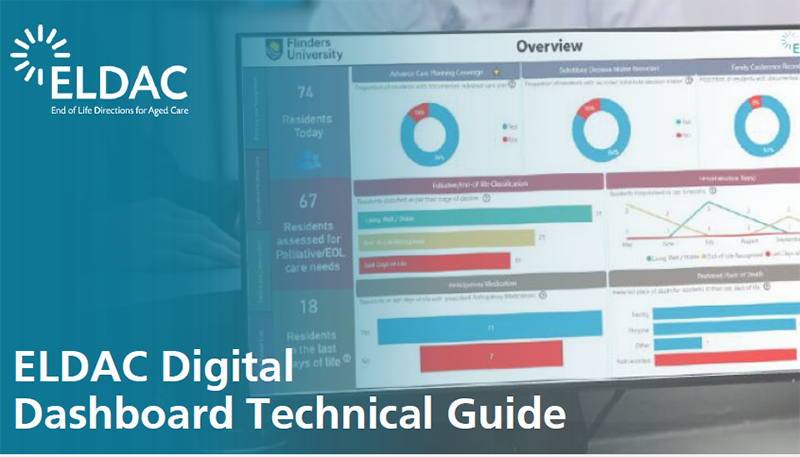
Seeing is believing! Have a sneak peek of the Dashboard BI model.

Note: The Dashboard is designed for residential aged care services. A separate solution for Support at Home is in development.

Made for you, not for purchase

The ELDAC Dashboard is now available as a Power BI model, enabling aged care services to build and implement it in-house. We provide everything you need: the complete model, data specifications, implementation guides, and support. The model is provided at no cost. It represents over a decade of research and evidence translation to improve care of older Australians.

Backed by a program, not just a tool

The Dashboard is part of the comprehensive ELDAC program. When you identify gaps in care practice, you can draw on the full suite of ELDAC resources: the Linkages program for service improvement support, the knowledge hub for evidence-based guidance, and toolkits for clinical practice. The Dashboard shows you where to focus. The ELDAC program gives you the tools to act.

Why have the ELDAC Dashboard?

The dashboard moves your service from good intentions to visible, demonstrable end-of-life care practice. It provides a shared, evidence-informed view of care that supports action at the bedside, oversight at the service level, and accountability at an organisational level.

What the ELDAC Dashboard enables

  • Quality end-of-life care and palliative care practice

  • Operational oversight and compliance

  • Service level insight and improvement

The dashboard supports services to:
  • identify residents with emerging end-of-life and needs early
  • enable timely advance care planning
  • support ongoing family conversations.
The dashboard enables services to:
  • plan and monitor end-of-life care in real time
  • demonstrate alignment with Aged Care Quality Standard 5.7
  • strengthen audit and accreditation readiness via clear, structured evidence.
The ELDAC Dashboard enables organisations to:
  • apply a consistent view of end-of-life care across sites and services
  • facilitate cross-site benchmarking and improvement opportunities
  • use existing data to monitor and improve end-of-life care at scale.

See how it works for your role

Aged Care Staff and Clinicians

Make care needs visible when it matters most

The ELDAC Dashboard gives you real-time insight into your residents’ end-of-life needs. It helps you prioritise care, have timely conversations, and ensure residents’ preferences guide day-to-day practice.

  • Identify residents with emerging palliative needs and those in their last days of life.
  • View advance care planning status and family conversations.
  • Monitor hospitalisation trends and residents in the last days of life.

Fact sheet for care teams (335kb pdf)

Executives and Boards

Turn oversight into evidence-based assurance

The ELDAC Dashboard gives you confidence in the quality of end-of-life care across your service. It helps you see trends, identify where resources are needed, and ensure care aligns with sector expectations.
  • See end-of-life care activities tagged to relevant Quality Standard outcomes.
  • Review advance care planning completion and trends.
  • Track hospitalisation and resident decline trends to support oversight and resource allocation decisions.

Governance fact sheet (260kb pdf)

IT Teams and Digital Leads

Implement quickly. Work with the systems you have

The ELDAC Dashboard works with any clinical system using a standardised data layer and Power BI visualisation. Deployment is quick, with low maintenance, and designed to fit your existing IT environment.

  • Map your source system to the standardised ELDAC data model.
  • Use Microsoft Power BI Desktop or Service for visualisation.
  • Refresh data manually, on a schedule, or near real time.
  • Support multi-site deployment with row-level security or federated setup.
  • Typical deployment takes two to four weeks depending on internal capability.

Technical guide (362kb pdf)

Clinical Information System providers

Make your platform ELDAC Dashboard-ready

End-of-life care visibility is now a core sector expectation. Mapping your system to the ELDAC data points makes implementation simple for your clients and helps them deliver and demonstrate quality end-of-life care.

  • Meet client demand driven by Quality Standards.
  • Position your system as dashboard-ready to gain a competitive advantage.
  • Reduce implementation and support effort with clear field mapping.
  • Data element specifications and validation rules.
  • Field mapping templates and technical consultation.

Contact ELDAC to access template


Get in touch

Loading
  • Whether it’s technical, practical, or anything in between, we would love to hear from you. Fill out the form below to get in touch, discuss implementation options, access resources, or explore how the Dashboard could support your service.


Frequently asked questions

No, this Power BI model is designed specifically for residential aged care only. This is a deliberate decision. Home care (Support at Home) operates with fundamentally different workflows, care coordination models, funding structures, and data environments compared to residential aged care. The data elements and clinical processes needed for end-of-life care visibility in these two settings are distinct. We are developing a separate, purpose-built solution for Support at Home that reflects the unique characteristics of this setting. If you are a Support at Home provider interested in end-of-life care digital solutions, register your interest here to know about the home care solution when it becomes available.

The ELDAC Dashboard is not new. It was first developed in 2019-2020 and piloted across 14 residential aged care sites to test feasibility and clinical usefulness. That work established a strong, evidence-based foundation aligned with the nationally recognised ELDAC Care Model. What is being released now is the PowerBI version. Following aged care reforms commencing 1 November 2024, the Dashboard elements have been remapped to align with the strengthened Aged Care Quality Standards and rebuilt in Microsoft PowerBI to support easier implementation. Developed by Emergent Consulting under ELDAC direction, this release builds on rigorously tested work, delivering the Dashboard through systems already familiar to aged care services.

This dashboard was designed with aged care providers specifically for end-of-life care. It answers the questions you actually ask: Who needs an advance care planning conversation? Are we missing people? What do I show the assessors? The dashboard provides actionable clinical intelligence, not data dumps. It is purpose-built to support care at the end of life.

The ELDAC model itself is free. Your costs are Power BI licenses if you do not already have them, and potentially consultant fees for setup if you lack internal BI capability. After that, it is just your usual Power BI costs.

Yes. It gives you data-driven answers. You can show percentage of residents with documented advance care plans, how early palliative needs are identified, trends over time, and alignment with quality standards. It will not interpret the data for you, but it provides the information needed to inform clinical decisions, care planning, and evidence boards require.

Then you know where to focus improvement efforts and you can track whether changes are working. The Dashboard is not a performance management tool to punish services. It is a quality improvement tool. You may find you are doing better than you thought in some areas and have clear gaps in others. Visibility enables targeted action. Data-informed improvements are faster and more effective than working from assumptions. multiple aged care clinical information systems, using common data elements rather than a single vendor-specific solution.

Not against other organisations. External benchmarking would require sector-wide participation and data governance frameworks that do not exist yet. For multi-site providers, this is a major strength: you can compare performance across your own sites to identify what is working well and where gaps exist. Internal benchmarking allows comparison within your own context and creates opportunities to learn from high-performing teams within your organisation.

Start with the Get in Touch form. You will connect with the ELDAC Dashboard lead who can discuss your situation, answer questions, and help you understand next steps. No commitment required to have the conversation.