
-
Home Care Clinical Care Assess Your Knowledge Organisational Support
Respond to Deterioration
Responding to deterioration in people with dementia ensures:
- Signs of deterioration are identified early and addressed.
- Timely management of symptoms.
- Complications may be prevented.
What does deterioration in people with dementia look like?
Deterioration refers to signs that the health of the person with dementia is declining. In late dementia, symptoms significantly worsen, impacting memory, communication, and physical abilities. Recognising deterioration can be challenging due to the gradual progression of the disease. This can sometimes make it difficult to identify when palliative care is needed.
Typical Illness Trajectories
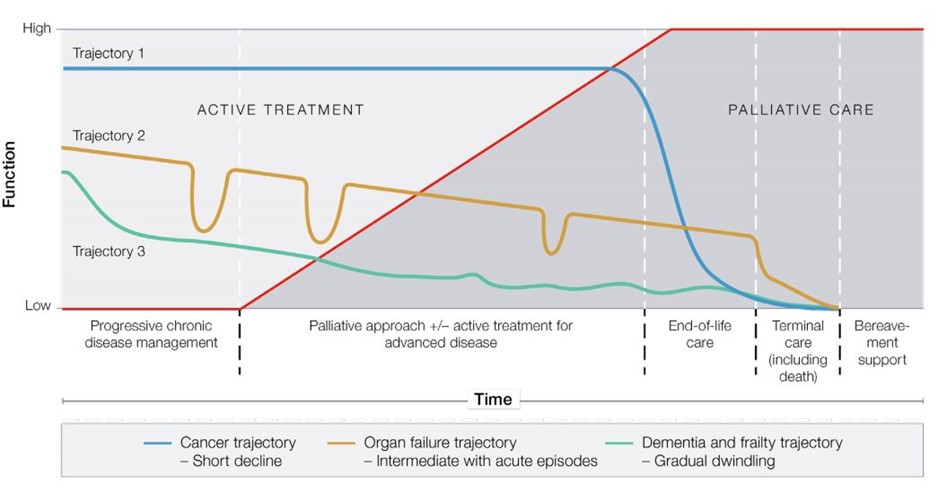
People will experience different illness trajectories depending on the primary diagnosis and presence of other diseases (co-morbidities). Three typical illness trajectories for people with progressive chronic illness are described and illustrated in the figure below. [1, 2]
Trajectory 1: Cancer (short decline)
For these individuals there is a steady progression with a slight decline in physical health over months to years. Evident decline occurs in the end-of-life phase, which includes increasing symptoms, rapid decline in weight and functional status in the last weeks or months of life. [1, 2]
Typical illness trajectories and palliative care phases towards the end of life
Reproduced with permission from: The Royal Australian College of General Practitioners. RACGP aged care clinical guide (Silver Book). 5th edition. East Melbourne, Vic: RACGP, 2019, 2020. Available at www.racgp.org.au/silverbook
Page updated 23 September 2026
This website may capture information to improve user experience. By using our website you consent to this in accordance with our Privacy Statement.