
-
Home Care Clinical Care Assess Your Knowledge Organisational Support
Overview of End of Life Law in Australia
Health professionals and personal care workers have a significant role in caring for and supporting older people at the end of life. Caring for someone at the end of life can be challenging, especially when it involves interacting with the law. This factsheet gives an overview of end of life law that relates to medical treatment and aged care, and discusses why it is important to know the law.
Clarifying the law
This factsheet explains:
- What end of life law is
- The role of end of life law in aged care
- The Australian legal system
- Key end of life laws relevant to aged care
- Where to go for information about State and Territory end of life laws
What is end of life law?
Broadly, end of life law covers legal issues that are relevant to medical decisions made at the end of life.
There are different views across the palliative, aged care, medical and other health sectors about what ‘end of life’ means. End of life law relates to decisions that happen in the ‘last days and months of life’, as well as the planning and decision-making that happens well before this, including before a person has an illness or injury.
What is the role of end of life law in aged care practice?
The law establishes a broad framework for end of life decision-making and advance care planning.
Health professionals, including those working in the aged care sector, play important legal roles. For example, in aged care you may be called upon to:
- decide whether to follow a person’s Advance Care Directive;
- identify the substitute decision-maker for a person who does not have capacity;
- decide whether life-sustaining treatment can lawfully be withheld or withdrawn;
- determine the appropriate level of pain and symptom relief that can be given to an aged care recipient approaching the end of life; and
- decide whether or not to provide urgent medical treatment, or transfer a person to hospital.
The law also establishes processes for resolving disputes, for example, with families and substitute decision-makers.
Why knowing the law is important
Knowing the law can improve your aged care practice. For example, understanding the law can:
- Help you to manage difficult situations that arise in your practice. A common example is uncertainty about whether it is lawful to provide medication for pain and symptom relief to a person. Knowing the law can help you understand what action is allowed, and enable you to provide appropriate care.
- Improve your communication with older people, their families and substitute decision-makers. Disputes about treatment and care can often arise because of different understandings about the law.
- Enhance your confidence and ability to support people receiving aged care, their families, or your colleagues where legal issues arise. An example is a resident seeking your help to make an Advance Care Directive.
- Prevent legal risk. Better legal knowledge can help you to act lawfully, and reduce the risk of criminal or civil liability.
End of life law in Australia
At the end of life, the law that applies can differ depending on whether or not a person has decision-making capacity. The law also differs across Australia, as each State and Territory has its own law about key areas of end of life e.g. guardianship and medical treatment legislation.
Law in Australia comes from two main sources: Common Law (law made by judges in court decisions) and Statute Law (legislation made by Commonwealth, State and Territory parliaments).
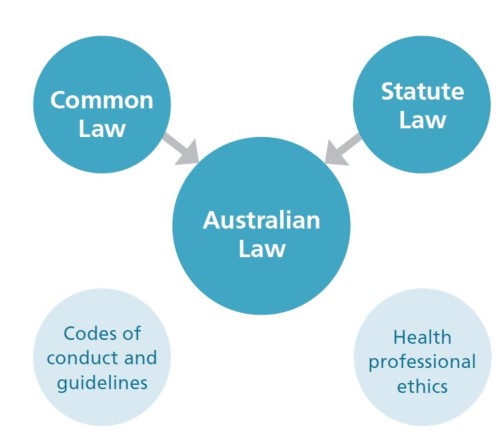
Australian health professionals and personal care workers are also regulated by codes of conduct, quality and safety standards, and guidelines. Health professional ethics also has a role in guiding decision-making.
Codes, guidelines and ethical frameworks are not binding i.e. enforceable in the same way as the law. However, they are important as they establish minimum professional standards of conduct when providing end of life care, and guide ethical decision-making and practice. They are also used by courts, tribunals or disciplinary bodies (e.g. in disciplinary proceedings, cases involving alleged negligence, or other investigations) when they make decisions about appropriate standards of a health professional’s or aged care provider’s care or conduct.
Applying the law in practice can be complicated
If you are unsure of the law, or how it applies in your aged care practice, you should discuss your concerns with your manager. They may wish to seek legal advice about the appropriate course of action. If you are a GP, you can contact your medical insurer or your medical defence organisation for advice.
Overview: Key areas of end of life law
-
Capacity and Consent to Medical Treatment
-
Substitute Decision-Making
-
Withholding and Withdrawing Life-Sustaining Treatment
-
Legal Protection for Administering Pain and Symptom Relief
-
Futile or Non-Beneficial Treatment
-
Urgent (emergency) Medical Treatment
-
Managing Disputes about Medical Treatment Decision-Making
-
Voluntary Assisted Dying
Learn more about end of life law
For further information visit:
- the ELDAC End of Life Law Toolkit for factsheets, mythbusters and cases studies on each topic above.
- End of Life Law in Australia, a website to assist health professionals and the community to navigate end of life law. It provides information about the law in each Australian State and Territory.
- End of Life Law for Clinicians, a free online training program for medical practitioners, nurses, and allied and other health professionals about end of life law across Australia.
Page updated 28 September 2026
This website may capture information to improve user experience. By using our website you consent to this in accordance with our Privacy Statement.